
Discover XQ-Power Servos in Our eBay Store!
Shop Now
Technical Specifications
Last Updated: 2026-09-14| Identity | |
| Brand |  |
| Product Number | 33322S |
| Category | Hobby |
| Performance | |
| Torque |
6.0V
51.00 oz-in
3.67 kg-cm
0.4 N-m
4.8V
42.00 oz-in
3.02 kg-cm
0.3 N-m
Below Average
|
| Speed |
6.0V
0.15 sec/60°
400.0 deg/s
66.7 RPM
4.8V
0.19 sec/60°
315.8 deg/s
52.6 RPM
Average
|
| Running Current |
6.0V
0.180 A
180 mA
4.8V
0.160 A
160 mA
Above Average
|
| Stall Current | 0.7–0.8 A700–800 mATop 10% |
| Physical | |
| Weight | 1.52 oz43.0 gAbove Average |
| Dimensions |
L 1.57 in W 0.78 in H 1.43 in L 39.9 mm W 19.8 mm H 36.3 mm |
| Case Material | Plastic |
| Drivetrain | |
| Motor Type | 3-pole |
| Gears | Plastic |
| Gear Spline/Teeth | 24 T |
| Shaft Size | 6.0 mm |
| Rotation Mode | Positional |
| Rotation/Support | Bushing |
| Backlash | 0.500° |
| Control & Signal | |
| Modulation | Analog |
| Direction | Clockwise |
| Rotational Range | 120° |
| Pulse Cycle | 20 ms |
| Pulse Width | 900-2100 µs |
| Neutral Position | 1500 µs |
| Dead Band | 5 µs |
| Refresh Rate | 50 Hz |
| Angle Sensor | Potentiometer |
| Control System | PWM |
| Programmable | No |
| Signal Voltage | 3-5V |
| Electrical & Environment | |
| Operating Voltage | 4.8–6 V |
| Temperature | -20–60 °C-4–140 °F |
| Water Rating | IP40 |
| Idle Current | 0.008 A8 mA |
| Connectivity | |
| Connector | S |
| Wire Length | 300 mm11.81 in |
Disclaimer: Most data is sourced from the manufacturer. Some data is sourced from our loyal community and with the help of AI. We aim for accuracy but are not responsible for inaccurate information.
Class Comparison
| Torque | Below Average Stronger than 13% of 187 Analog Standard servos at 4.8V |
| Speed | Average Faster than 38% of 185 Analog Standard servos at 4.8V |
| Weight | Above Average Lighter than 72% of 444 Analog Standard servos |
| Running Current | Above Average Lower draw than 82% of 45 Analog Standard servos at 4.8V |
| Stall Current | Top 10% Lower draw than 93% of 62 Analog Standard servos |
Performance Analysis
| Shaft Power | 0.41–0.63 W |
| Power Density | 0.359 W/in³ More power-dense than 24% of 435 Analog Standard servos |
| Torque Density | 0.9767 oz-in/g Stronger than 11% of 187 Analog Standard servos |
| Torque-to-Volume Ratio | 23.98 oz-in/in³ Denser torque than 16% of 187 Analog Standard servos |
| Speed-to-Weight | 0.12240 (1/sec·g) Faster than 61% of 185 Analog Standard servos |
| Speed-Torque Trade-off | 7.98 Better balanced than 15% of 185 Analog Standard servos |
| Current-per-Torque Ratio | 0.0190 A/oz-in More efficient than 44% of 56 Analog Standard servos |
| Idle-to-Running Current Ratio | 0.050 Lower idle draw than 42% of 34 Analog Standard servos |
| No-Load vs Stall Current Spread | 5.00 Narrower current spread than 84% of 32 Analog Standard servos |
| Torque Gain per Volt | 17.86%/V More voltage-responsive (torque) than 64% of 141 Analog Standard servos |
| Speed Gain per Volt | 22.22%/V More voltage-responsive (speed) than 85% of 143 Analog Standard servos |
| Voltage Range Width | 1.2 V Wider voltage range than 63% of 223 Analog Standard servos |
| Backlash-to-Range Ratio | 0.00417 Tighter backlash than 61% of 29 Standard servos |
| Dead-Band-to-Pulse-Width Ratio | 0.0042 Finer dead band than 47% of 48 Analog Standard servos |
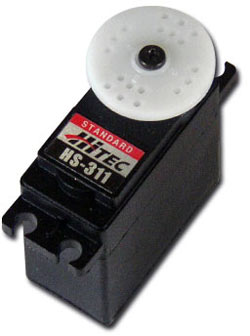
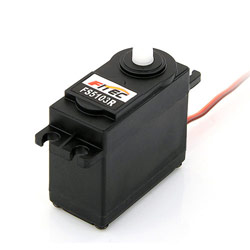
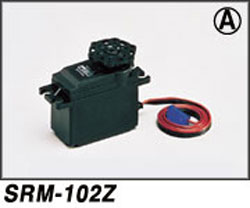
Similar Active Servos

Reviews (3)
-
alexM
March 8, 2016Application(s): Light robotics
Comments: Allegedly 'heavy duty', with 'Karbonite' gears -- BUT both descriptors are misleading. Has 2 Karbonite and 2 nylon gears and in light use they both break easily. It's not a heavy duty servo by any means.
With a full range of input pulse widths, 544-2400 uS., its rotational range is ~190 deg. With more usual RC input range of 900-2100 uS. it will output ~155 deg. of rotation.
JBruce
July 8, 2010Application(s): used as leg servos in a small hexapod robot, 3 dof per leg.
Comments: I would absolutely not recommend these for robotic applications or anything that experiences high mechanical shock. The resin gears do not stand up to the stress of walking impact. I've had 3 of these fail in the last month.
Great for low stress areas but they cannot handle any shock,
do not fall for resin gear advertisement.jason.hodge
November 7, 2009Application(s): 4 Channel R/C Aircraft - 4.8V
Comments: I had 1, maybe 2 of these brand new servo's fail on my aircraft's maiden flight. All things tested fine on the ground, but one of them, mainly the elevator servo, failed during flight. I had to send all 4 in the plane to Hitec for service. I sent 4 more that I purchased, back to the dealer for upgrade to Futaba 3004's. No more Hitec for me!