
Discover XQ-Power Servos in Our eBay Store!
Shop Now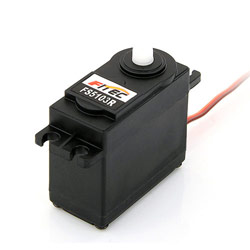
Technical Specifications
Last Updated: 2026-10-22
Weight
Dimensions
Torque
Speed
Current
Temp
Wire
| Identity | |
| Brand |  |
| Product Number | FS5103R |
| Category | Robotics |
| Performance | |
| Torque |
6.0V
44.50 oz-in
3.20 kg-cm
0.3 N-m
4.8V
36.17 oz-in
2.60 kg-cm
0.3 N-m
Bottom 10%
|
| Speed |
6.0V
0.13 sec/60°
480.0 deg/s
80.0 RPM
4.8V
0.15 sec/60°
389.6 deg/s
64.9 RPM
Above Average
|
| Running Current |
6.0V
0.210 A
210 mA
4.8V
0.130 A
130 mA
Above Average
|
| Stall Current | ≤1.1 A≤1100 mAAbove Average |
| Physical | |
| Weight | 1.46 oz41.5 gAbove Average |
| Shape | Boxed |
| Dimensions |
L 1.579 in W 0.793 in H 1.464 in L 40.1 mm W 20.1 mm H 37.2 mm |
| Case Material | Nylon / Fiberglass |
| Drivetrain | |
| Motor Type | Cored |
| Gears | Nylon |
| Gear Spline/Teeth | 25 T |
| Rotation Mode | Continuous |
| Rotation/Support | Dual Bearings |
| Control & Signal | |
| Modulation | Analog |
| Direction | Counterclockwise |
| Rotational Range | 360° |
| Mechanical Limit | No Limit |
| Pulse Width | 700-2300 µs |
| Neutral Position | 1500 µs |
| Dead Band | 10 µs |
| Control System | PWM |
| Electrical & Environment | |
| Operating Voltage | 4.8–6 V |
| Temperature | -15–70 °C5–158 °F |
| Idle Current | 0.006 A6 mA |
| Connectivity | |
| Connector | JR (Universal) estimate |
| Wire Length | 300 mm11.81 in |
| Origin | |
| Country of Origin | China |
Disclaimer: Most data is sourced from the manufacturer. Some data is sourced from our loyal community and with the help of AI. We aim for accuracy but are not responsible for inaccurate information.
Class Comparison
| Torque | Bottom 10% Stronger than 3% of 198 Analog Standard servos at 4.8V |
| Speed | Above Average Faster than 77% of 195 Analog Standard servos at 4.8V |
| Weight | Above Average Lighter than 80% of 447 Analog Standard servos |
| Running Current | Above Average Lower draw than 90% of 49 Analog Standard servos at 4.8V |
| Stall Current | Above Average Lower draw than 68% of 63 Analog Standard servos |
Performance Analysis
| Shaft Power | 0.43–0.66 W |
| Power Density | 0.359 W/in³ More power-dense than 24% of 432 Analog Standard servos |
| Torque Density | 0.8716 oz-in/g Stronger than 5% of 198 Analog Standard servos |
| Torque-to-Volume Ratio | 19.73 oz-in/in³ Denser torque than 3% of 198 Analog Standard servos |
| Speed-to-Weight | 0.15647 (1/sec·g) Faster than 87% of 195 Analog Standard servos |
| Speed-Torque Trade-off | 5.57 Better balanced than 3% of 195 Analog Standard servos |
| Current-per-Torque Ratio | 0.0304 A/oz-in More efficient than 8% of 54 Analog Standard servos |
| Idle-to-Running Current Ratio | 0.046 Lower idle draw than 54% of 38 Analog Standard servos |
| No-Load vs Stall Current Spread | 8.46 Narrower current spread than 32% of 35 Analog Standard servos |
| Torque Gain per Volt | 19.19%/V More voltage-responsive (torque) than 70% of 156 Analog Standard servos |
| Speed Gain per Volt | 19.34%/V More voltage-responsive (speed) than 72% of 156 Analog Standard servos |
| Voltage Range Width | 1.2 V Wider voltage range than 21% of 239 Analog Standard servos |
| Dead-Band-to-Pulse-Width Ratio | 0.0063 Finer dead band than 27% of 56 Analog Standard servos |
Similar Active Servos


Reviews (3)
Includes 3 reviews aggregated from around the web.
There are few reviews for this servo on the web. Most posts about it are makers working out how to calibrate and stop a continuous-rotation servo with a microcontroller, with no verdict on the servo itself. One user running them nonstop for a plant-rotation project reported that both stopped working after about six days of continuous operation, which is far beyond normal use for this type of servo.
Be the first to review!