
Discover XQ-Power Servos in Our eBay Store!
Shop Now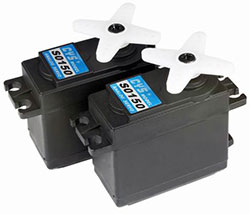
Technical Specifications
Last Updated: 2026-10-09
Weight
Dimensions
Torque
Speed
Current
Temp
Wire
| Identity | |
| Brand |  |
| Product Number | CYS-S0150 |
| Category | Hobby |
| Performance | |
| Torque |
7.2V
208.31 oz-in
15.00 kg-cm
1.5 N-m
6.0V
194.42 oz-in
14.00 kg-cm
1.4 N-m
Top 10%
|
| Speed |
7.2V
0.12 sec/60°
500.0 deg/s
83.3 RPM
6.0V
0.14 sec/60°
428.6 deg/s
71.4 RPM
Above Average
|
| Running Current |
7.4V
0.300 A
300 mA
6.0V
0.200 A
200 mA
Average
|
| Stall Current | 2.7–3.2 A2700–3200 mABottom 10% |
| Physical | |
| Weight | 2.05 oz58.0 gBelow Average |
| Dimensions |
L 1.606 in W 0.791 in H 1.496 in L 40.8 mm W 20.1 mm H 38.0 mm |
| Drivetrain | |
| Motor Type | Cored |
| Gears | Metal |
| Gear Spline/Teeth | 25 T |
| Rotation Mode | Positional |
| Rotation/Support | Single Bearing |
| Control & Signal | |
| Modulation | Analog |
| Direction | Counterclockwise |
| Rotational Range | 90° |
| Mechanical Limit | 45° |
| Pulse Width | 1000-2000 µs |
| Neutral Position | 1500 µs |
| Dead Band | 4 µs |
| Control System | PWM |
| Electrical & Environment | |
| Operating Voltage | 6–7.4 V |
| Temperature | -10–50 °C14–122 °F |
| Idle Current | 0.020 A20 mA |
| Connectivity | |
| Connector | JR (Universal) estimate |
| Wire Length | 300 mm11.81 in |
| Origin | |
| Country of Origin | Austria |
Disclaimer: Most data is sourced from the manufacturer. Some data is sourced from our loyal community and with the help of AI. We aim for accuracy but are not responsible for inaccurate information.
Class Comparison
| Torque | Top 10% Stronger than 94% of 192 Analog Standard servos at 6.0V |
| Speed | Above Average Faster than 85% of 190 Analog Standard servos at 6.0V |
| Weight | Below Average Lighter than 17% of 448 Analog Standard servos |
| Running Current | Average Lower draw than 51% of 50 Analog Standard servos at 6.0V |
| Stall Current | Bottom 10% Lower draw than 5% of 64 Analog Standard servos |
Performance Analysis
| Shaft Power | 2.57–3.21 W |
| Power Density | 1.689 W/in³ More power-dense than 96% of 437 Analog Standard servos |
| Torque Density | 3.3521 oz-in/g Stronger than 95% of 192 Analog Standard servos |
| Torque-to-Volume Ratio | 102.30 oz-in/in³ Denser torque than 95% of 192 Analog Standard servos |
| Speed-to-Weight | 0.12315 (1/sec·g) Faster than 64% of 190 Analog Standard servos |
| Speed-Torque Trade-off | 27.22 Better balanced than 84% of 190 Analog Standard servos |
| Current-per-Torque Ratio | 0.0165 A/oz-in More efficient than 63% of 58 Analog Standard servos |
| Idle-to-Running Current Ratio | 0.100 Lower idle draw than 26% of 39 Analog Standard servos |
| No-Load vs Stall Current Spread | 16.00 Narrower current spread than 8% of 37 Analog Standard servos |
| Voltage Range Width | 1.4 V Wider voltage range than 84% of 229 Analog Standard servos |
| Dead-Band-to-Pulse-Width Ratio | 0.0040 Finer dead band than 58% of 49 Analog Standard servos |
Similar Active Servos


Reviews of CYS S0150
Be the first to review!