
Discover XQ-Power Servos in Our eBay Store!
Shop Now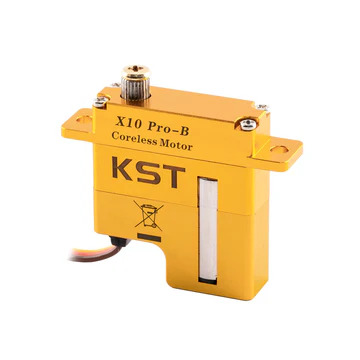
Technical Specifications
Last Updated: 2026-10-23| Identity | |
| Brand |  |
| Product Number | X10 Pro-A: BR0023.0229-A; X10 Pro-B: BR0023.0229-B |
| Category | Hobby |
| Performance | |
| Torque |
8.4V
159.62 oz-in
11.49 kg-cm
1.1 N-m
7.4V
145.74 oz-in
10.49 kg-cm
1.0 N-m
6.0V
117.98 oz-in
8.50 kg-cm
0.8 N-m
4.8V
90.22 oz-in
6.50 kg-cm
0.6 N-m
Below Average
|
| Speed |
8.4V
0.10 sec/60°
600.0 deg/s
100.0 RPM
7.4V
0.12 sec/60°
500.0 deg/s
83.3 RPM
6.0V
0.14 sec/60°
428.6 deg/s
71.4 RPM
4.8V
0.16 sec/60°
375.0 deg/s
62.5 RPM
Below Average
|
| Physical | |
| Weight | 0.88 oz25.0 gTop 10% |
| Dimensions |
L 1.181 in W 0.394 in H 1.319 in L 30.0 mm W 10.0 mm H 33.5 mm |
| Case Material | Aluminum |
| Drivetrain | |
| Motor Type | Coreless |
| Gears | Steel |
| Gear Spline/Teeth | 25 T |
| Rotation Mode | Positional |
| Rotation/Support | Dual Bearings |
| Control & Signal | |
| Modulation | Digital |
| Rotational Range | 120° |
| Pulse Cycle | 3.003 ms |
| Pulse Width | 900-2100 µs |
| Neutral Position | 1500 µs |
| Dead Band | 2 µs |
| Refresh Rate | 333 Hz |
| Angle Sensor | Potentiometer |
| Control System | PWM |
| Programmable | Yes |
| Signal Voltage | 3.3–5V |
| Electrical & Environment | |
| Operating Voltage | 4.8–8.4 V |
| Temperature | -10–65 °C14–149 °F |
| Connectivity | |
| Connector | JR (Universal) estimate |
Disclaimer: Most data is sourced from the manufacturer. Some data is sourced from our loyal community and with the help of AI. We aim for accuracy but are not responsible for inaccurate information.
Class Comparison
| Torque | Below Average Stronger than 15% of 1055 Digital Standard servos at 4.8V |
| Speed | Below Average Faster than 34% of 1038 Digital Standard servos at 4.8V |
| Weight | Top 10% Lighter than 99% of 1872 Digital Standard servos |
Performance Analysis
| Shaft Power | 1.04–2.95 W |
| Power Density | 4.812 W/in³ More power-dense than 78% of 1762 Digital Standard servos |
| Torque Density | 3.6088 oz-in/g Stronger than 53% of 1048 Digital Standard servos |
| Torque-to-Volume Ratio | 147.11 oz-in/in³ Denser torque than 64% of 1053 Digital Standard servos |
| Speed-to-Weight | 0.25000 (1/sec·g) Faster than 92% of 1031 Digital Standard servos |
| Speed-Torque Trade-off | 14.44 Better balanced than 22% of 1029 Digital Standard servos |
| Torque Gain per Volt | 21.37%/V More voltage-responsive (torque) than 87% of 868 Digital Standard servos |
| Speed Gain per Volt | 16.67%/V More voltage-responsive (speed) than 57% of 868 Digital Standard servos |
| Voltage Range Width | 3.6 V Wider voltage range than 84% of 1552 Digital Standard servos |
| Dead-Band-to-Pulse-Width Ratio | 0.0017 Finer dead band than 44% of 501 Digital Standard servos |
Similar Active Servos


Reviews (1)
Includes 1 review aggregated from around the web.
Owners are mixed, based on a small number of reports. A German forum thread tells of a new unit that began trembling badly after two flights, and another owner found one of four unused units vibrating at first power-up, which a poster says usually points to a faulty potentiometer. Glider pilots otherwise trust the brand for aileron and flap work, with fewer problems than most. No widespread failure pattern was reported.
Be the first to review!